Why Installing a Concrete Paver Patio is a Smart Investment
How to install a concrete paver patio involves excavating, building a compacted base, laying pavers, and filling the joints. Here's the essential process:
- Excavate 6-8 inches deep for patios (8-12 inches for driveways).
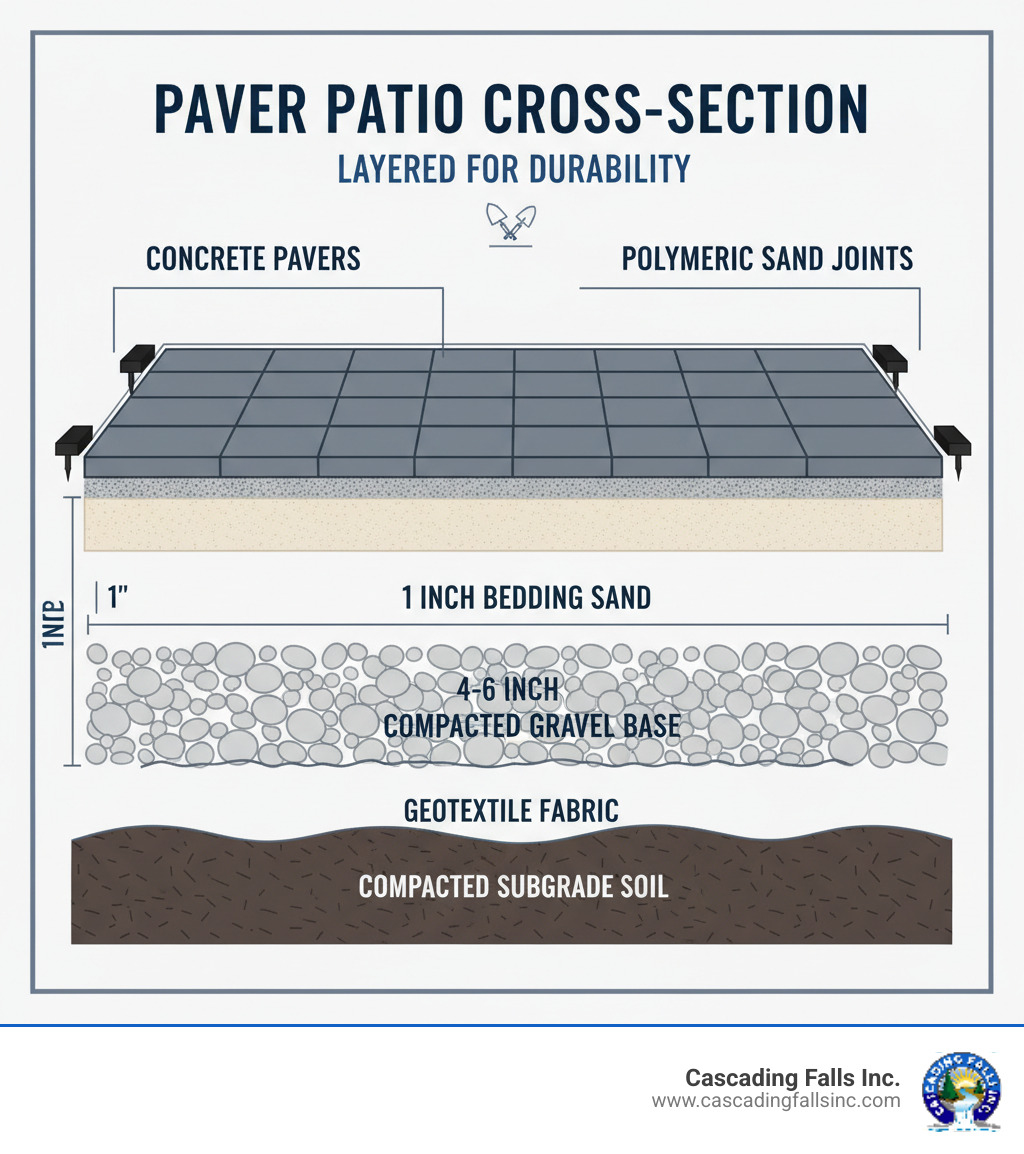
- Build the base with 4-6 inches of compacted gravel.
- Add 1 inch of bedding sand and level it.
- Lay pavers using the 'click and drop' method.
- Install edge restraints to prevent shifting.
- Fill joints with polymeric sand and compact.
- Activate sand with water to lock pavers in place.
A concrete paver patio transforms your outdoor space and increases property value. Unlike poured concrete, pavers are durable, resist cracking, and are easy to replace individually. With minimal maintenance, they withstand heavy traffic and harsh weather for decades, offering endless design flexibility with various colors, shapes, and patterns.
But here's the truth: paver installation is a physically demanding DIY project where attention to detail is critical. The foundation is everything. A properly installed base with correct drainage prevents the settling and shifting that ruin poorly executed projects. Cutting corners on the base will cost you later.
This guide details every step, from calculating materials to laying the final paver, teaching you the professional techniques for a long-lasting patio.
I'm David Shelly, and I've been in landscape construction since 2005, with 15 years running my own business installing hardscapes. I've learned that knowing how to install a concrete paver patio correctly from the start saves time, money, and frustration.
Step 1: Planning, Preparation, and Materials
The secret to a great paver patio is preparation. Spending time on planning now prevents costly redos later.
Before you dig, call 811. This free service marks underground utility lines, preventing a dangerous and expensive accident. While you wait, choose a relatively level patio location with good natural drainage, ensuring water flows away from your house foundation.
Essential Tools and Materials
Gathering all your supplies first is crucial.
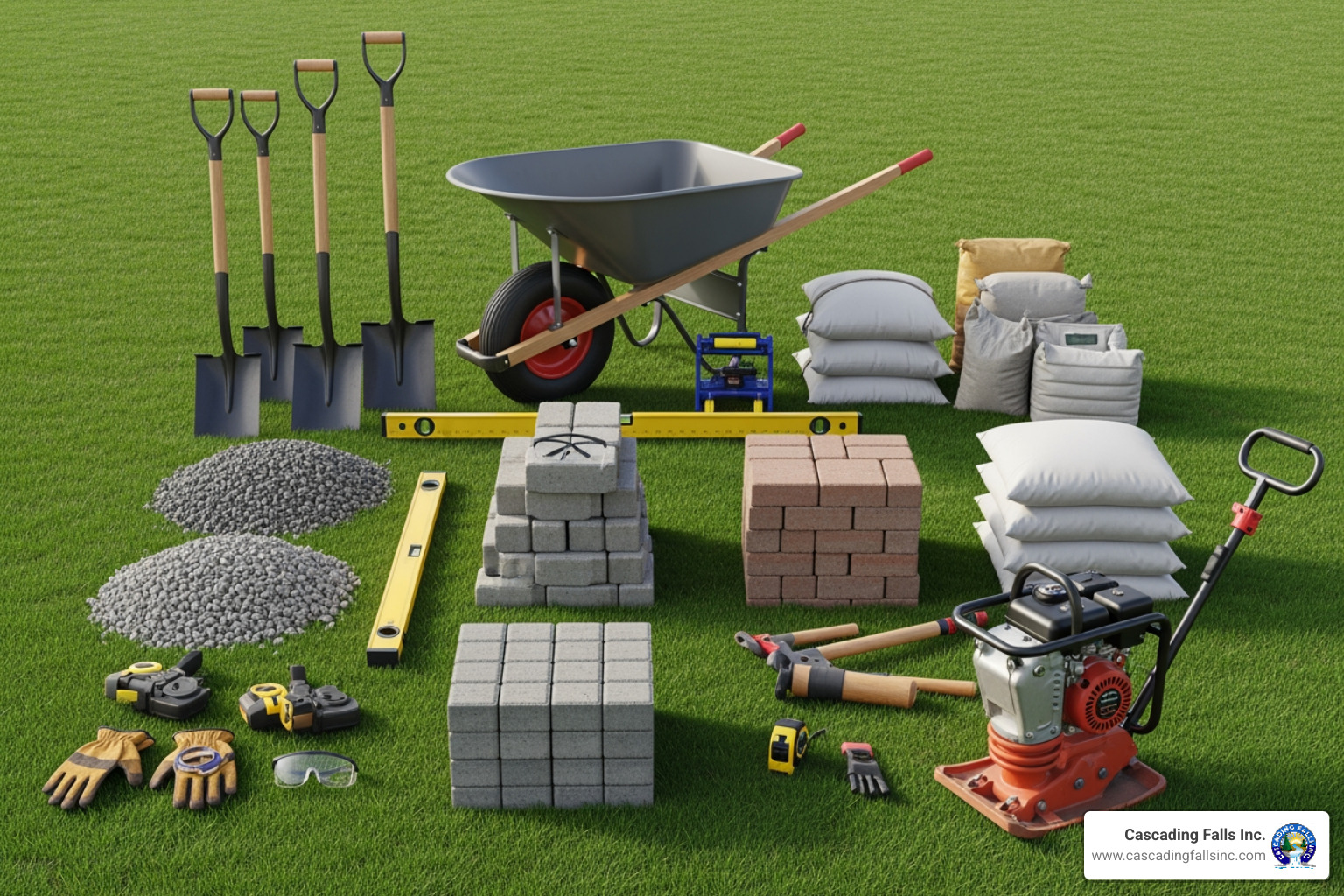
Tools: You'll need a shovel, wheelbarrow, tape measure, and a long carpenter's level. A plate compactor is essential for a solid base (rent one for $75-$100/day), with a hand tamper for tight corners. For laying pavers, have a rubber mallet, two screed rails(3/4" metal pipes), and a straight 2x4 screed board. For cutting, a masonry saw with a diamond blade provides the cleanest cuts. Safety glasses, work gloves, and a dust mask are non-negotiable, especially when cutting pavers to avoid inhaling silica dust. You'll also need stakes and string line, a broom, and a garden hose with a spray nozzle.
Materials: Choose your concrete pavers, crushed stone/gravel base(3/4" minus), and washed concrete sand for bedding (not play sand). Get edge restraints and spikes, polymeric sand for joints, and consider geotextile fabric for unstable or clay-heavy soil to separate the base from the subgrade.
Calculating Quantities and Marking Your Layout
To avoid running out of materials, calculate your needs carefully. Measure your patio's length and width to find the square footage (e.g., 12 ft x 16 ft = 192 sq ft).
- Pavers: Order 10-15% extra for cuts and breakage.
- Gravel Base: Plan for 1 ton per 100 sq ft for a 4-inch depth (about 2 tons for a 192 sq ft patio).
- Bedding Sand: One cubic yard covers about 300 sq ft at a 1-inch depth.
- Edge Restraints: Measure the patio's perimeter to get the total linear footage.
For help, use this Product Estimator.
To mark your layout, drive stakes at the corners and run string lines between them. Use the 3-4-5 triangle method for perfect 90-degree corners: measure 3 feet along one line and 4 feet along the adjacent line. The diagonal between those points must be exactly 5 feet. Adjust your stakes until it is.
Always use proper lifting techniques: bend at your knees, not your waist. If you'd rather leave the heavy lifting to us, you can find more info about our landscaping services.
With your site planned and materials ready, you can break ground. This prep work is what separates a lasting patio from one that fails.
Step 2: Building a Rock-Solid Foundation
You can lay the most beautiful pavers, but if the foundation is weak, your patio has an expiration date. The base is everything —it prevents your patio from becoming a wavy, sunken mess.
Excavation and Achieving Proper Drainage
This is where the physical work of how to install a concrete paver patio begins.
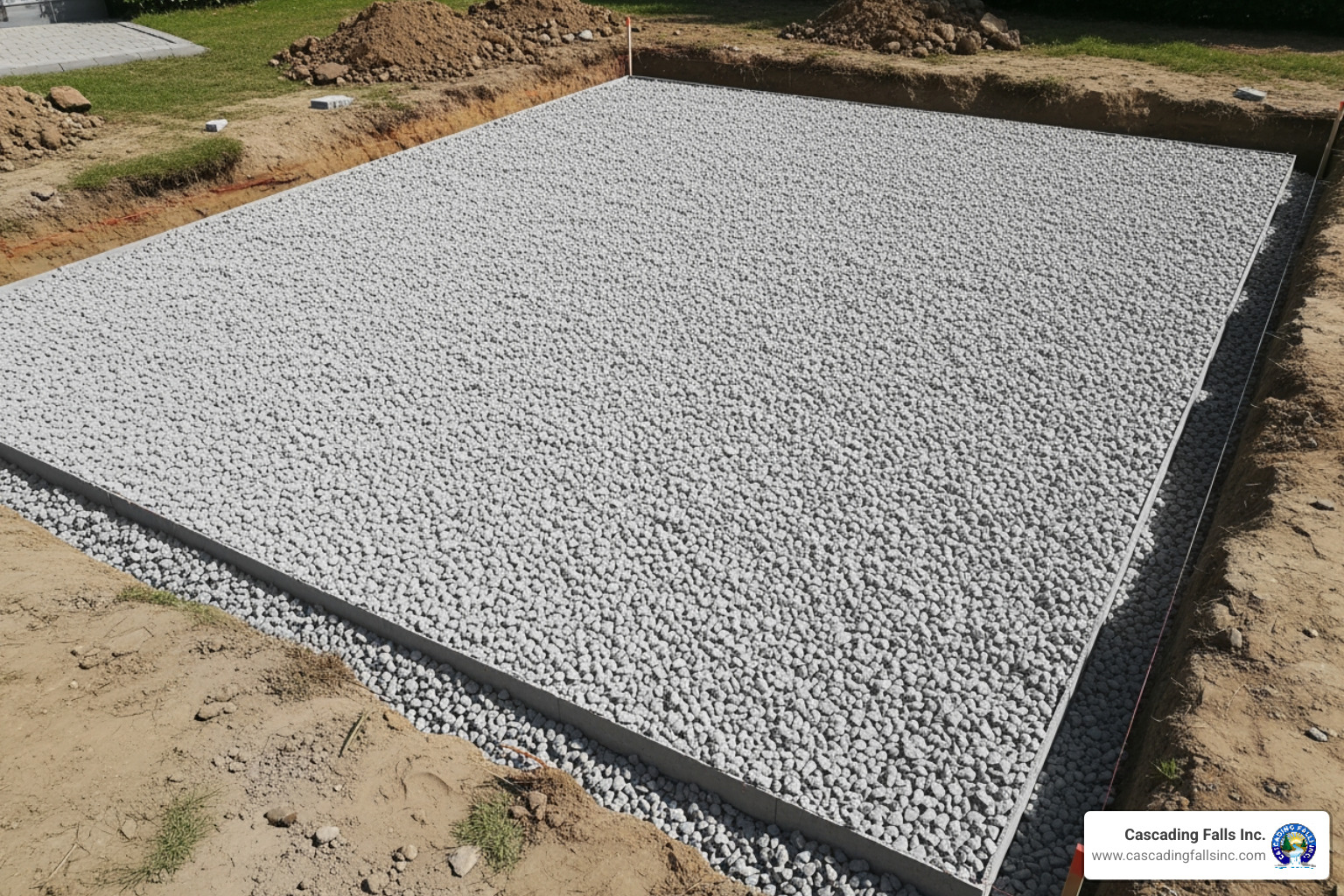
Excavation depth is key: dig 6 to 8 inches for a pedestrian patio and 8 to 12 inches for a driveway. If you have clay-heavy soil, common around Roseville and Sacramento, dig an extra inch or two for better drainage.
Next, establish a drainage slope. Your patio must slope away from your house foundation. Aim for a 1/4 inch drop for every foot of patio (e.g., a 1-inch drop over 4 feet). Use your string lines and a line level to set this slope across the entire area. Don't eyeball it, or you'll end up with puddles.
Once excavated, compact the subgrade soil with a plate compactor. Make several passes until the earth is firm and stable to prevent future settlement.
Installing the Gravel Base and Bedding Sand
Now, build the structural layers. If you have sandy or clay soil, first lay geotextile fabric over the compacted subgrade. This separator keeps your gravel from mixing with the soil while allowing water to drain.
The gravel base is the workhorse. You'll need 4 to 6 inches of crushed stone for a patio. The key is to build it in 2-inch layers. Spread 2 inches of gravel, lightly mist it with water, and run the plate compactor over it until it's solid. Repeat this process for each layer. This method is crucial for a long-lasting patio.
With the gravel base compacted and sloped, add the bedding sand. Spread a uniform 1-inch layer of washed concrete sand(not play sand). To level it perfectly, use a technique called screeding. Place two 3/4-inch metal pipes parallel on the gravel, pour sand between them, and drag a straight 2x4 board across the pipes to scrape off the excess. This leaves a perfectly flat, 1-inch surface. Remove the pipes, fill the voids, and smooth them gently. Crucially, do not walk on the screeded sand.
Getting this foundation right is what makes a patio last. At Cascading Falls Inc., we never cut corners on the base, which is why our landscaping services deliver patios that stand the test of time.
Step 3: How to Install a Concrete Paver Patio Paver by Paver
This is where your hard work pays off and your patio comes to life. Precision and consistency are key to a professional-looking result, so work methodically.
Choosing a Pattern and Laying the First Pavers
First, choose your pattern. This affects both aesthetics and strength.
- Running bond: The easiest pattern for DIYers, with staggered joints like a brick wall. It requires fewer cuts.
- Herringbone: A strong, interlocking zigzag pattern ideal for driveways but requires more cuts.
- Basket weave: A traditional woven look created by alternating pairs of pavers.
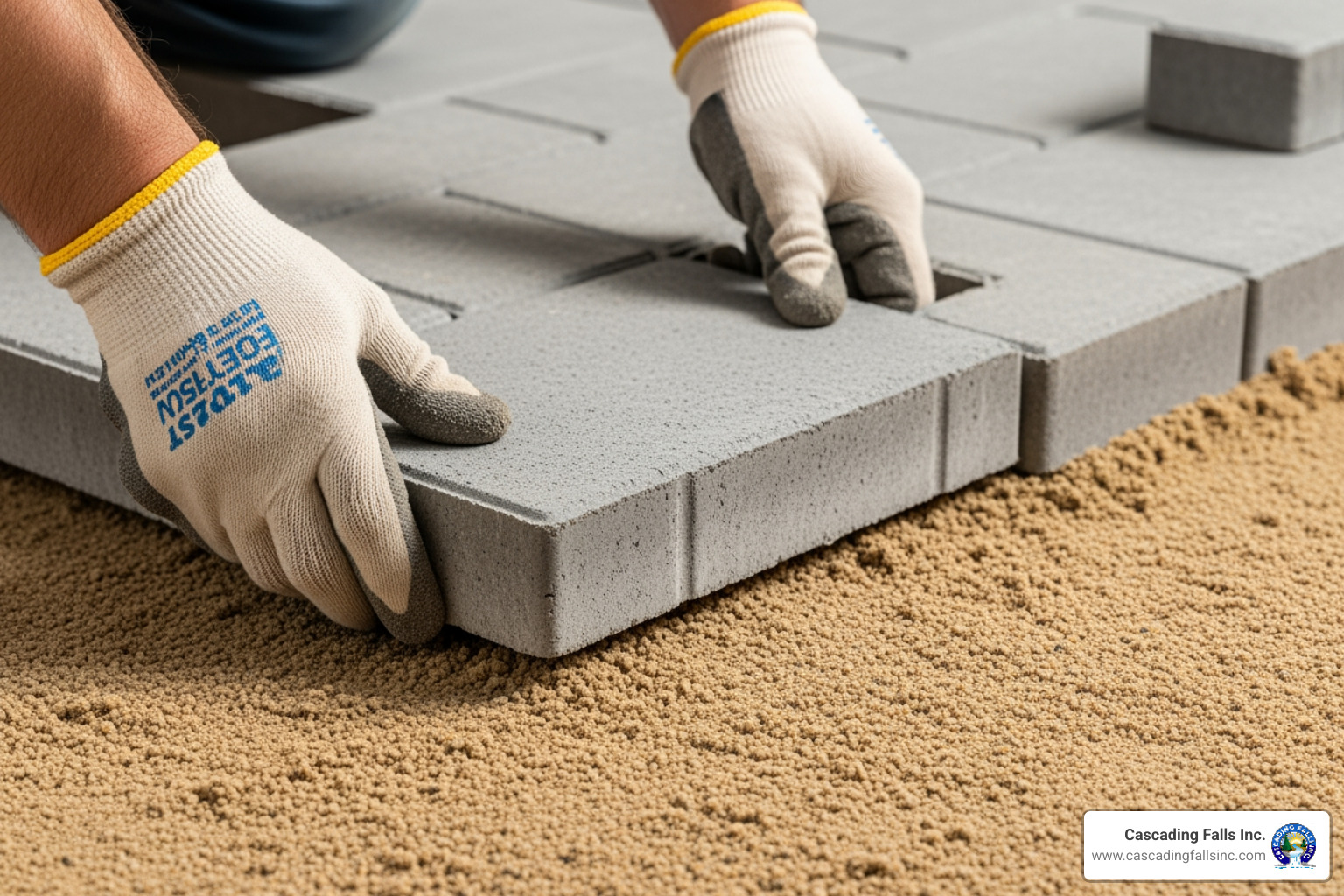
Always start laying pavers from a fixed, 90-degree corner, like where the patio meets your house. This keeps everything aligned. Use the 'click and drop' method: hold a paver at an angle, 'click' its edge against the previously laid one, and 'drop' it straight down. Never slide pavers into place, as this will disturb the sand bed.
Run string lines across the area every few feet to keep your rows straight, and check your alignment frequently. After placing a paver, tap it gently with a rubber mallet to set it. Every few pavers, use your level to check for an even surface. It's much easier to fix a high or low spot immediately. Work from the pavers you've already laid, kneeling on a piece of plywood to distribute your weight.
How to Install a Concrete Paver Patio with Custom Cuts and Edging
Not every paver will fit perfectly; you'll need to make cuts. But first, install edge restraints. These are essential to prevent your patio from spreading apart over time. Plastic or aluminum edging, secured with spikes every 12-18 inches, is great for curves and most DIY projects. Install it after laying the main field of pavers but before fitting the edge pieces.
For cuts, measure carefully and mark the paver with a pencil. Remember to account for the 1/8-inch joint width. A masonry saw with a diamond blade provides the cleanest cuts. Always wear your safety glasses, hearing protection, and dust mask—concrete dust is hazardous. Make your cuts away from the patio area to keep debris out of the joints.
For straight cuts, make a steady pass with the saw. For curves, you can make a series of small straight cuts and chip away the excess with a hammer and chisel. Measure twice, cut once—it's a cliché for a reason.
At Cascading Falls Inc., we have extensive experience with custom cuts and intricate patterns. If you're tackling a complex design and want professional craftsmanship, learn more about our specialized concrete services.
Step 4: Finishing Touches for a Lasting Patio
You've done the heavy lifting. These finishing touches lock in your work and ensure your patio lasts for decades.
Compacting Pavers and Applying Polymeric Sand
First, run a plate compactor over the entire patio to settle the pavers. Crucially, attach a protective pad to the compactor's base to avoid scratching or chipping the pavers. Make two to three passes over the surface.
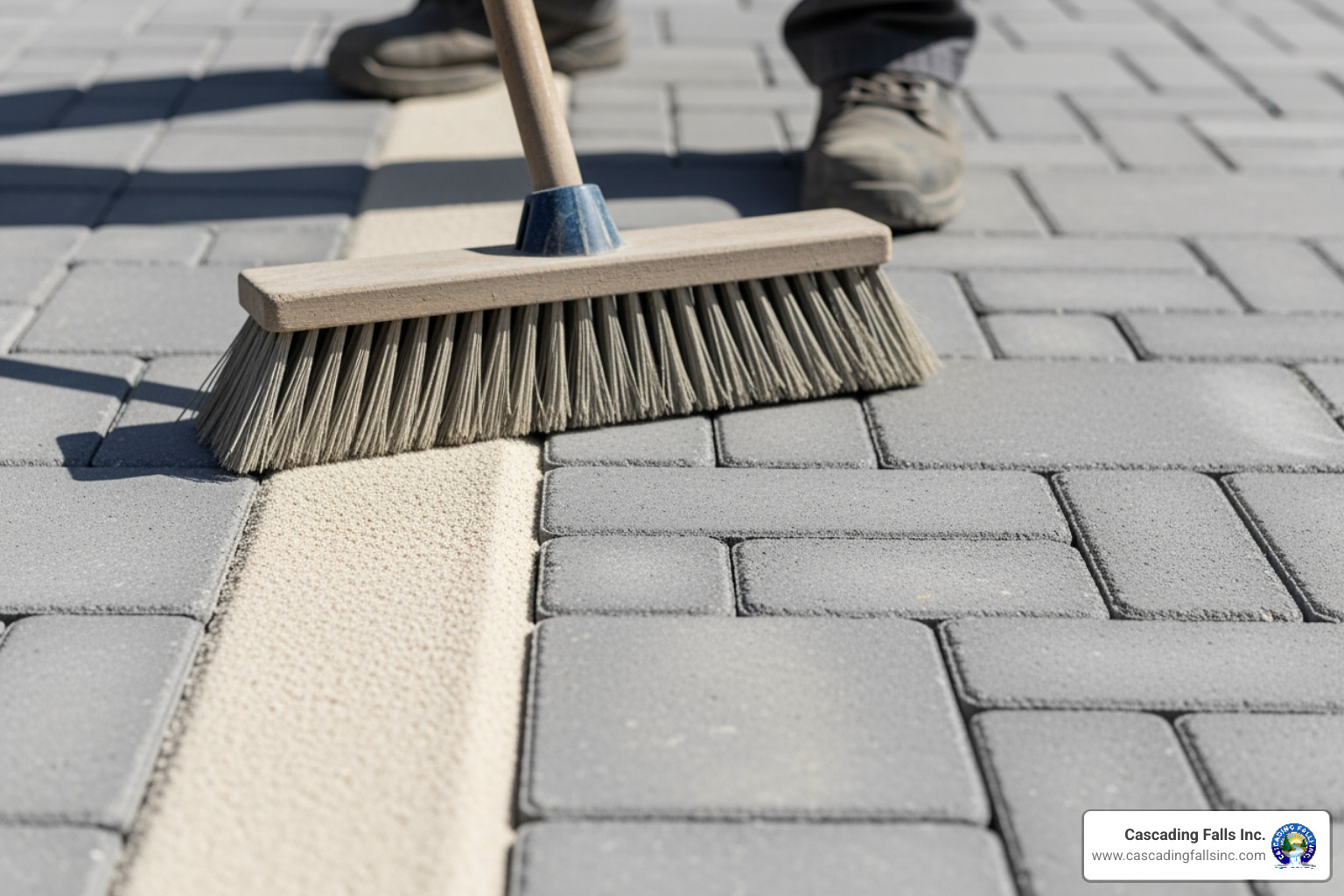
Next, apply polymeric sand. This engineered sand contains polymers that harden when wet, locking pavers together. It prevents weeds, deters insects, and won't wash out in the rain. Pour the sand generously over the dry patio and use a stiff broom to sweep it into every joint from multiple directions until they are completely full.
Run the plate compactor over the patio again to vibrate the sand deep into the joints. Top off any low spots with more sand. The joints should be filled to about 1/8 inch from the paver surface.
Finally, activate the sand. Before wetting, use a leaf blower or broom to remove all sand residue from the paver surfaces to prevent a hazy film. Then, using a garden hose with a fine mist or shower nozzle, gently wet the entire patio. The goal is to saturate the joints without washing the sand out. The sand will harden in about 24 hours.
Sealing and Long-Term Paver Maintenance
Sealing your patio is optional but recommended. A good sealer improves color, protects against stains from oil and food, and can slow UV fading. However, sealers add cost and need reapplication every 2-5 years. If you choose to seal, wait until the polymeric sand has fully cured (24-48 hours) and the surface is clean.
Long-term maintenance is simple:
- Sweep regularly to remove debris.
- Rinse with a hose to wash away dirt.
- Use a designated paver cleaner for stubborn stains, avoiding harsh chemicals.
- Avoid de-icing salts in winter; use sand for traction instead.
- Check for and re-level any sunken pavers annually.
Regular maintenance will keep your pavers looking great for years. Proper installation and minimal upkeep mean you'll enjoy your space for decades.
Frequently Asked Questions about Paver Installation
You've walked through the process, but a few questions might remain. Here are answers to the most common ones.
Can I install pavers over an existing concrete slab?
Yes, this is called an overlay and can save significant time and money on excavation. However, there are critical considerations. The added height of the pavers (2-3 inches) can create tripping hazards at doorways or steps. Also, since concrete isn't permeable, you must drill weep holes at the slab's lowest points to allow water to drain.
Your existing slab must be in good condition. Major cracks or settling in the concrete will transfer to your paver surface. For DIYers, the easiest method is laying pavers on a 1-inch sand bed over the slab.
What are the most common installation problems and how do I fix them?
- Uneven or sinking pavers: This is almost always caused by an improperly compacted base. The only real fix is to remove the affected pavers, re-compact the gravel base, re-level the sand, and reinstall the pavers.
- Weeds in joints: This happens when regular sand is used or polymeric sand isn't activated correctly. To fix, clean out the joints and reapply polymeric sand, following the activation steps carefully.
- Efflorescence: This is a natural, white, chalky haze that can appear on new pavers as salts migrate to the surface. It typically fades over time with rain and weathering, but specialized cleaners can speed up the process.
When should I DIY versus hiring a professional for my paver patio?
Deciding whether to DIY or hire a pro depends on the project's complexity and your own resources.
Consider DIY if:
- Your project is small and straightforward (e.g., a simple rectangular patio).
- Your yard is relatively flat with stable soil.
- You have the time, physical stamina, and access to the right tools (especially a plate compactor).
Consider hiring a professional when:
- The design is large or complex, with curves, multiple levels, or intricate patterns.
- Your site has severe slopes, poor drainage, or other challenging conditions.
- You lack the time or desire to take on a multi-day, labor-intensive project.
A professional installation from a company like Cascading Falls Inc. comes with expertise, efficiency, and a warranty. We've installed countless patios across Roseville and Sacramento, and our "Whatever It Takes..." approach ensures the job is done right the first time.
Your Beautiful New Patio Awaits
You now know how to install a concrete paver patio from start to finish. If you tackle this project yourself, you're in for hard work but also an incredible sense of accomplishment. A properly installed paver patio is a smart investment that adds lasting value and beauty to your home.
Unlike poured concrete, pavers are durable, low-maintenance, and easy to repair. They handle freeze-thaw cycles and resist settling when built on a solid foundation.
However, not every project is ideal for DIY. If your design involves multiple levels, intricate patterns, or challenging slopes, professional expertise is invaluable. Large-scale projects also benefit from the specialized equipment and experience a pro brings.
That's where we come in. Cascading Falls Inc. offers comprehensive concrete services to bring your vision to life with precision. Serving Roseville, Sacramento, and the surrounding region, our team's "Whatever It Takes..." commitment guarantees a warrantied, professional, and impressive finished patio. We handle the heavy lifting so you can enjoy the results.
Your beautiful new patio is waiting. Whether you build it yourself or partner with us, you're about to transform your outdoor living space.