Why Proper Yard Drainage Matters for Your Property
A dry well for yard drainage is an underground system that collects excess water from your yard, roof, or driveway and slowly releases it into the surrounding soil, preventing puddles, erosion, and foundation damage.
Quick Answer: Key Components of a Dry Well System
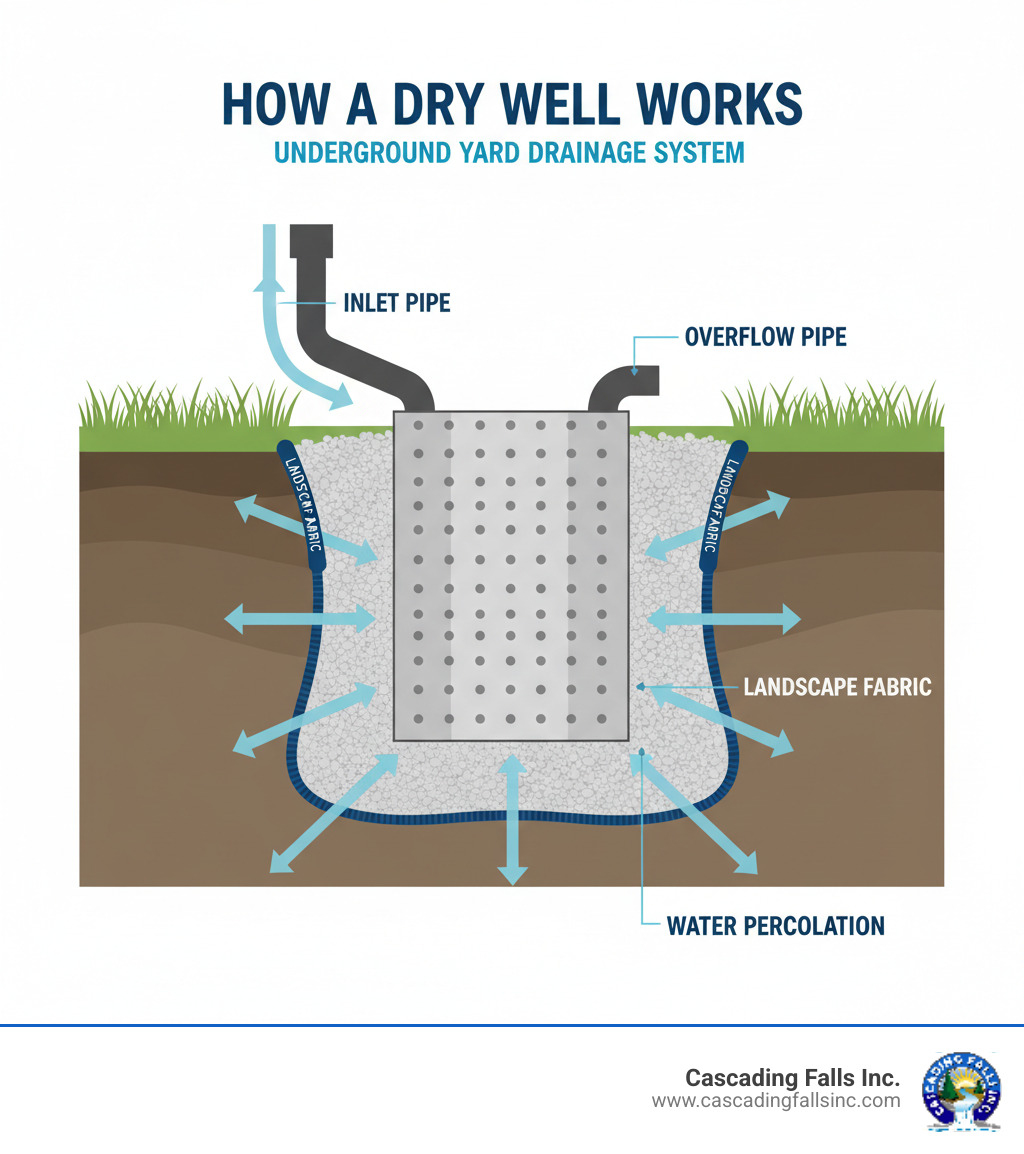
- Underground storage chamber- A perforated barrel or pre-fabricated tank buried 4+ feet deep
- Gravel backfill- Surrounds the chamber to facilitate water dispersion
- Inlet pipe- Redirects water from downspouts or problem areas (sloped 1/4" per foot)
- Landscape fabric- Prevents soil from clogging the system
- Overflow pipe- Manages excess water during heavy storms
If you've ever watched storm water race across your lawn, washing out flowerbeds and creating icy patches on walkways in winter, you understand the frustration of poor yard drainage. Standing water doesn't just create muddy eyesores. It can cause severe, costly problems. Constant moisture saturation creates hydrostatic pressure against your foundation walls, leading to cracks, leaks, and in worst-case scenarios, structural failure. Furthermore, those persistent puddles are prime breeding grounds for mosquitoes, which can carry diseases and make your yard unusable. Poor drainage can even cause tension with neighbors if your runoff consistently floods their property.
A dry well offers an invisible, environmentally friendly solution. Unlike surface drainage systems, it works underground to capture and store water temporarily while it infiltrates into the soil. By promoting groundwater recharge, dry wells also play a role in maintaining local water tables and reducing the volume of polluted runoff entering municipal storm systems. This solution is particularly effective when traditional gravity-based options like French drains won't work because your problem area sits at the lowest point in your yard.
Is a dry well right for your property? That depends on three critical factors: your soil's percolation rate (how quickly water absorbs), your water table level, and the volume of runoff you need to manage. Sandy or loamy soils work best, while heavy clay soil drains too slowly to support most dry well systems effectively.
The good news is that installing a dry well is a manageable DIY project for many homeowners. With materials costing around $70 for a pre-fabricated unit plus $125 for stone and piping, you can typically complete installation in one day. However, the physical labor of digging a 4-foot-deep pit can be strenuous. For larger commercial properties or more complex drainage challenges, professional installation ensures proper sizing and compliance with local regulations.
I'm David Shelly, and with nearly two decades of hands-on experience in landscape construction and home improvement projects, I've designed and installed countless dry well for yard drainage systems for both residential and commercial clients. My team and I have seen how a properly installed system can transform a soggy, unusable yard into a healthy, stable landscape. Throughout this guide, I'll walk you through everything you need to know—from testing your soil to digging the pit and connecting the pipes—so you can solve your drainage problems once and for all.
What is a Dry Well and Is It Right for Your Yard?
Think of a dry well for yard drainage as nature's underground sponge. It's essentially a buried reservoir—usually a perforated container surrounded by gravel—that catches excess water and gives it time to slowly soak back into the earth. Instead of watching rainwater rush across your driveway or pool against your foundation, you're redirecting it to a hidden chamber where it can do what water naturally wants to do: return to the ground.
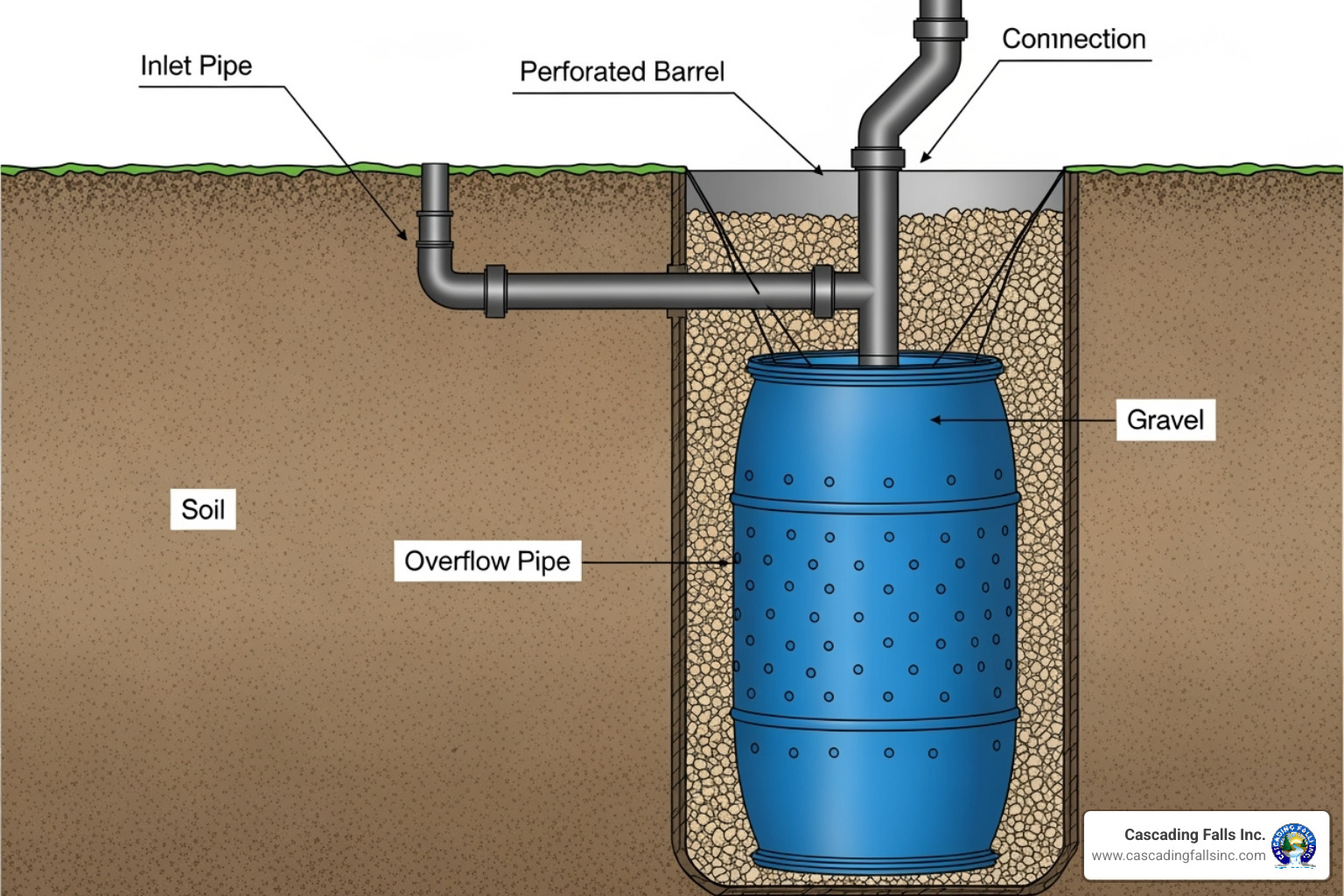
The beauty of this system is its invisibility. Once you've installed it and covered everything with topsoil and grass, no one would ever know it's there. Your yard looks pristine while the dry well quietly handles runoff management beneath the surface. This makes it particularly valuable here in Roseville and Sacramento, where we need effective drainage solutions that don't compromise our outdoor living spaces.
Beyond keeping your lawn dry, a dry well also helps with groundwater recharge —meaning you're actually returning water to underground aquifers rather than sending it straight to storm sewers. It prevents soil erosion, protects your landscaping investments, and reduces strain on storm sewers during heavy California rains. If you're interested in comprehensive drainage solutions as part of a larger landscape project, you can explore our landscaping services.
You might be wondering how a dry well stacks up against a French drain, since both handle excess water. They're actually cousins in the drainage family, but they work differently. While a French drain is excellent for intercepting and redirecting water spread over a large area (like at the base of a hill), a dry well is the champion for handling concentrated points of water, such as the output from multiple downspouts or a low spot in the yard.
| Feature | Dry Well | French Drain |
|---|---|---|
| Purpose | Collects and stores water in one spot for slow infiltration | Redirects water away from problem areas through a long trench |
| Installation Depth | 4-6 feet deep concentrated pit | 1-3 feet deep extended channel |
| Ideal Use Case | Best for capturing large volumes from downspouts or low points | Best for intercepting water along slopes or foundation walls |
How a dry well works
The mechanics are refreshingly simple. Water flows through an inlet pipe into your underground storage chamber—this could be a perforated container like a pre-fabricated plastic tank, or even a DIY pit filled with large stones. The container has holes that allow water to escape, but not all at once. Surrounding the container is gravel backfill that creates extra storage space and facilitates water dispersion into the soil. A critical, non-negotiable component is the landscape fabric that lines the pit. It acts as a filter, preventing fine soil particles and silt from migrating into the gravel. Without it, the system would quickly clog and fail, a condition known as siltation. This simple layer of fabric is the key to the system's longevity.
As the water gradually seeps out through the perforations and into the surrounding gravel, it undergoes natural filtration through layers of soil before joining the groundwater below. This slow percolation is exactly what you want—it prevents the system from overwhelming the soil while keeping your yard surface dry.
Key factors for a dry well for yard drainage
Not every yard is a perfect candidate for a dry well, and understanding the limitations upfront saves you time and money. The most critical factor is your soil type. Sandy or loamy soils drain beautifully and make ideal conditions. Clay soils? Not so much. Clay soil limitations can make a dry well nearly useless since water simply can't infiltrate quickly enough, essentially creating a hidden underground swamp.
The percolation rate —how fast water absorbs into your soil—determines whether a dry well will work at all. We'll talk about testing this in a moment, but generally you need soil that can absorb at least an inch of water per hour. Your property slope matters too, since you want to position the dry well downhill from your water source when possible, allowing gravity to do the work.
Finally, consider your water table level. If groundwater sits high on your property, there's simply no room for your dry well's water to go. It's crucial to consider the seasonal high water table, which is often much higher during the rainy season. The bottom of your dry well pit must be at least 2-3 feet above this seasonal high mark to ensure there is unsaturated soil available to absorb the water. Digging a deep test hole and observing it during your region's wettest season is the most reliable way to assess this.
Performing a Soil Percolation Test
Before you break ground, you absolutely need to test whether your soil can handle a dry well. This simple test takes about a day but saves you from installing a system that won't work.
Start by digging a test hole about 12 inches wide and 12 inches deep in the area where you're considering the dry well. Next comes saturation —fill the hole with water and let it drain completely. Then fill it again and let it sit overnight. This pre-soaks the soil to simulate saturated conditions during a storm.
The next day, fill the hole with water one more time and start measuring water drop. Use a ruler or tape measure to track how much the water level falls over one hour. If it drops at least one inch per hour, you're in business. Calculating infiltration rate is that straightforward—you're literally just measuring inches per hour.
This suitability assessment tells you whether to move forward. If your soil drains too slowly (less than one inch per hour), a standard dry well will not function correctly. Don't despair, as you may still have options. You might need to consider alternatives like a catch basin connected to a solid discharge pipe, or combine your dry well with a sump pump system to actively move the water. For detailed installation guidance, This Old House offers a comprehensive guide that complements the information here.
The good news? If your soil passes the test, you're ready to move forward with planning and installation. And if you'd rather leave the testing and installation to professionals who've done this hundreds of times, that's exactly what we do at Cascading Falls Inc.